Languru pairs learners with a persistent AI companion — named and personalized during onboarding — who adapts to their pace, picks up where they left off, and turns the intimidating work of mastering a new language into small, daily rituals.
A short intake survey filtered for adult learners with prior language-app experience and an active reason to keep learning — travel, work, family, or self-directed study. The screener captured current app, target language, and self-rated level to seed segmentation.
Eight qualified participants sat for one-on-one conversations. An eight-question protocol probed daily habits, Duolingo experience, pain points, AI expectations, motivation, and vocabulary strategies — open-ended, with room to follow tangents.
Roughly 64 observations were transcribed onto sticky notes and clustered by behavior and motivation — not demographics. Three themes surfaced, each pointing toward a distinct product capability that became the foundation of the design direction.
Every participant said a variation of the same sentence: "I just want to actually talk." The threads underneath that wish split into three — each becoming a product capability.
"Duolingo just randomly teaches words. I'd prefer a more logical way to learn." Participants wanted a path shaped by why they were learning — not a single global curriculum applied to everyone.
Vocabulary arrived detached from the situations participants actually needed it for — a clinic visit, a business trip, a conversation with a spouse's family. The scenarios didn't transfer.
Recognition exercises were too easy; speaking was missing. Participants asked for AI that could adjust to their level, weak spots, and learning behaviors over time — not a static curriculum.
The market is crowded with apps that teach learners to recognize a word. The moment someone has to produce language in a real situation — order a coffee, run a meeting, comfort a patient — most of them freeze.
What they wanted wasn't another curriculum. It was a safe place to rehearse — with someone endlessly patient.
8 semi-structured interviews with adult learners; deep competitive teardown of Duolingo and reference scans of TALKIE and emerging AI-language apps.
Synthesized findings into personas, journey maps, and three jobs-to-be-done: chat, talk, play.
Low-fi wireframes through four iterations, usability-tested at each. Settled on a four-tab IA.
Hi-fi screens and an interactive prototype in Figma; design system and brand direction finalized with Yaxin.
A final validation pass surfaced friction; prioritized six high-impact fixes to onboarding and the practice loop.
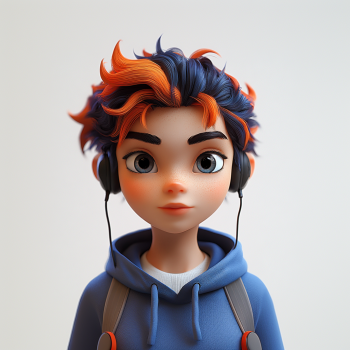
The AI has a name, a face, and a voice. Learners aren't talking to a system — they're talking to Steven, who happens to know nine languages.
Every study plan is anchored to a real-life context the learner named during onboarding. "Business Trip to Germany" beats "Unit 4: Travel Phrases."
No streaks, no public rankings. Progress is a quiet private ring — visible when you want it, invisible when you don't.
At every screen the learner knows exactly what to tap next. No dashboards-of-dashboards, no decision paralysis.
The home screen doesn't overwhelm. Three big modes — Chat, Talk, Game — and a quiet list of what Emily was doing yesterday.
"Business Trip Guidance" is the plan, not "Unit 4." Learners pinned the plan they cared about most, tapped into bite-size sessions, and ended each day on a low-stakes quiz.
Some days learners want to curl up with a book or a podcast. Explore is the room that holds all of it — resources, translation tools, and community-published study plans — but only appears when the learner goes looking.
Profile is where a learner's story lives: pinned plans, the week's study time, and the habit streaks that quietly build. No gamified leaderboard, no public scoreboard — just the learner, their avatar, and a calm view of what they've done.
This project shipped in late 2024, before AI agents went mainstream. We leaned heavily on generative AI for UI assets, but the workflow was scattered — we hopped between platforms without a shared system. Today I'd treat AI as a workflow problem first, building an opinionated agent stack into design ops rather than reaching for whatever tool was open in another tab.
My partner brought deep landscape and branding instincts, but we worked almost entirely remote. For defined work — asset reviews, component handoffs — async was fine. For ambiguous early decisions like voice, naming, and scenario picks, ideas slipped past deadlines because we couldn't whiteboard together. Next time, I'd front-load a week of in-person time for the fuzziest calls.
We put ElevenLabs in front of the client as the leading voice partner; she opted to consider it, and the layer was never implemented. For a voice-first product, the partner choice is itself a product decision — not a deferred integration. Next pass, I'd lock it during design so the flows are shaped by its real constraints.
Thanks for reading. Languru taught me that a warm voice goes further than any clever feature.